Percutaneous Transhepatic Biliary Drainage (PTBD) is a minimally invasive procedure performed by an Interventional Radiologist to relieve a blockage in your bile ducts.
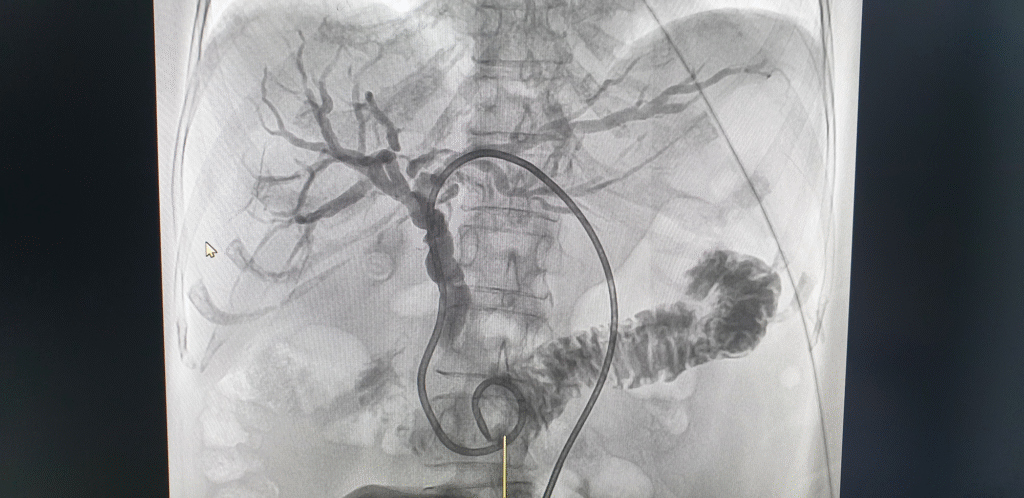
- Bile Ducts: These are tubes within the liver that carry bile (a digestive fluid) to the small intestine.
- Blockage: When the bile ducts are blocked (often by tumors, stones, or scarring), bile backs up into the liver, causing jaundice (yellowing of the skin and eyes) and can lead to serious infection.
- The Procedure: A small catheter (drainage tube) is inserted through the skin, across the liver, and into the blocked bile duct, using X-ray and ultrasound guidance. This catheter allows the bile to drain, either externally into a bag or internally into the intestine (with a subsequent procedure or catheter type).
Why do I need a PTBD?
The main goal of PTBD is to relieve the obstruction and drain the accumulated bile. This is typically done for:
- Relief of Symptoms: To quickly reduce jaundice, severe itching, and pain.
- Treating/Preventing Infection: To drain infected bile (cholangitis), which can be life-threatening.
- Preparation for Treatment: To improve liver function before surgery, chemotherapy, or other definitive treatments.
Risks and Complications
As with any medical procedure, there are potential risks and complications. Your medical team will take every precaution to minimize these. The overall rate of major complications is generally low.
| Complication | Description | Estimated Rate (Major Complications) |
| Catheter-Related Issues | The drainage catheter can become blocked (clogged with bile debris) or become dislodged (fall out or move). | Common minor/management issues (4) |
| Infection (Cholangitis/Sepsis) | Infection of the bile duct or bloodstream, despite preventative antibiotics. | Included in overall major complication rate (1) |
| Bleeding | Bleeding at the puncture site or internal bleeding in the liver. May require a blood transfusion. | Overall major complication rate: <3% (2). Overall complication rates (including minor) can range from 11.2% to 25.0% (3, 5). |
| Bile Leakage | Bile leaking around the catheter, which can cause pain or irritation inside the abdomen (peritonitis) or on the skin. | Included in overall complication rates (3) |
| Pneumothorax | Air leaking into the chest cavity near the lung. | Reported in low percentages, e.g., around 1% or less (3) |
Note: Percentage rates are based on clinical studies and can vary significantly depending on the patient’s underlying condition, health status, and the complexity of the procedure.
What to Expect After the Procedure
- Recovery: You will be monitored closely in the hospital for several hours and will likely remain in the hospital for at least 24 hours.
- Pain: Pain medication will be provided to manage discomfort at the drain site.
- Catheter Care: You will receive detailed instructions on how to care for your drain, including cleaning the site, changing the dressing, and emptying the drainage bag.
When to Call Your Doctor Immediately
Contact your healthcare provider or seek immediate medical care if you experience any of the following:
- Fever above 100.4∘F (or as instructed by your doctor) or chills.
- Severe pain at the drainage site or in your abdomen that does not improve with medication.
- Significant bleeding or increasing redness/swelling at the drain site.
- The drainage tube falls out or is completely blocked (no bile draining when it should be).
- New or worsening jaundice (yellowing of skin/eyes).
Sources:
- Royal Devon University Healthcare NHS Foundation Trust. Percutaneous Biliary Drainage (PBD) or Percutaneous Trans-Hepatic Cholangiogram (PTC). December 2023. Accessed September 30, 2025.
- Bhandari, N., et al. “Percutaneous Transhepatic Biliary Interventions.” Seminars in Interventional Radiology, vol. 34, no. 4, 2017, pp. 367-375. (Discusses technical success rates around 95-100% and major complication rate <3%).
- Nikolic, D., et al. “Clinical outcomes of percutaneous transhepatic biliary drainage at different Couinaud’s hepatic entry segments for treating obstructive jaundice.” Frontiers in Surgery, vol. 10, 2023. doi: 10.3389/fsurg.2023.1039106. (Source for range of complication rates and pneumothorax rate).
- Cleveland Clinic. “Biliary Drainage: What To Expect.” Last reviewed March 24, 2023. Accessed September 30, 2025.
- Wang, R., et al. “Percutaneous transhepatic biliary drainage (PTBD) in patients with dilated vs. nondilated bile ducts: technical considerations and complications.” European Radiology, vol. 32, no. 12, 2022, pp. 8382–8391. doi: 10.1007/s00330-022-08976-5. (Source for complication rates in different anatomical contexts).